


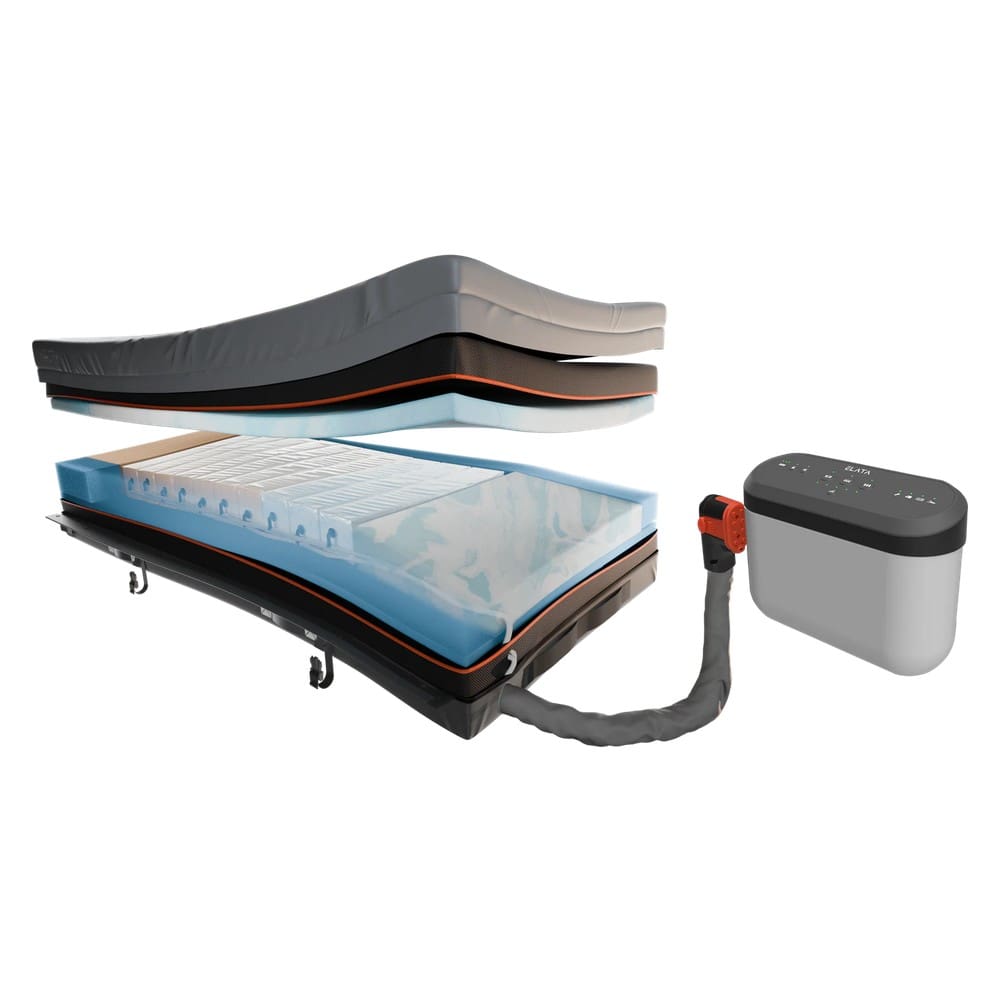


For OTs, physios & support coordinators
Choosing a home care bed comes down to how the person moves, how they transfer, who helps them and what the room allows. This guide works through the decision in the order a prescription usually needs it.
The 6-step process
1
Start with the person
Transfers, night-time behaviour, carer role and where the bed has to go.
2
Narrow the bed type
Four families of bed, each solving a different problem.
3
Set the functions and the load
How many profiling sections, and what the frame is rated to carry.
4
Decide on rails
Whether rails help, and what entrapment risk they bring.
5
Measure the room and the bed
Platform size, height range and clearance for a hoist.
6
Document it for funding
What the funder needs to see, and in what form.
Step 1. Start with the person
Most bed prescriptions are settled by four things: how the person moves in bed, how they get in and out, who helps them, and what the room allows. Work those out and the type usually picks itself.
- Bed mobility. Someone who repositions independently needs a firm surface and can be hindered by a deep pressure mattress. Someone who cannot needs profiling and a support surface matched to their pressure injury risk.
- Transfers. Sit to stand, stand transfer with one assist, board, or full hoist. Each has a different ideal bed height, and a hoist sets the clearance needed underneath.
- Night-time risk. Falls, agitation, seizures or a history of climbing over rails point to a low or floorline bed rather than more rails.
- Clinical needs. Raised backrest for respiratory or reflux conditions, leg elevation for oedema, wound care, tilt.
- Who provides care. A tall support worker and a short spouse need different working heights. Check the maximum height suits the tallest regular carer.
Step 2. Narrow the bed type
Standard homecare profiling bed
An electric hi-lo frame with a profiling platform, usually on braked castors, single or king single.
Floorline or low-low bed
The same profiling functions, but the platform drops far closer to the floor, in some models to roughly 100 to 250 mm, so a fall becomes a short roll. Often a better answer to falls risk than adding rails.
Bariatric bed
Built for higher loads and greater width. Many bariatric frames widen in steps, so match the width to the person rather than defaulting to the widest.
Paediatric bed
Children are not small adults. Paediatric beds fall under a separate standard, IEC 80601-2-89, written around children up to about 155 cm and 70 kg, with enclosing sides and tighter gap tolerances. For a growing child, ask about length extension.

Step 3. Set the functions and the load
- Two section: backrest only, enough for sitting up to eat or read.
- Three section: backrest and knee break, which reduces sliding down the bed when the backrest lifts.
- Four section: backrest, thigh and calf, so the lower leg can be set independently for oedema.
Ask about two more functions. Auto-regression moves the backrest back as it lifts, reducing shear. Tilt, including Trendelenburg, is specialised and not every frame offers it.
These are different numbers and confusing them is a common error. Safe working load is the total the bed is engineered to carry: person, mattress, bedding and accessories. Maximum user weight is the person alone. Subtract the mattress and accessories from the safe working load, then compare what is left to the person’s weight with a margin. Rails, lifting poles and the mattress carry their own ratings, and the lowest rated component sets the real limit.
The adult medical bed standard, IEC 60601-2-52 and its successor IEC 80601-2-52, is written around adults of at least 146 cm, 40 kg and a body mass index of 17. A person outside those figures sits outside the assumptions the bed was tested against, which matters for very small and very light adults as well as very heavy ones.
Step 4. Decide on rails
Rails are prescribed more often than they are assessed. Start with what the rail is for. A rail that helps a person roll and reposition is an enabler. A rail that stops a person getting out of bed is a restraint, and in NDIS and aged care settings that brings restrictive practice obligations for authorisation, consent and review.
Entrapment is the safety risk. Seven zones describe where a head, neck or chest can be trapped in a bed system. The widely used dimensional guidance sets four: openings within the rail, under the rail between supports, and between the rail and the compressed mattress should each be under 120 mm, and the gap under the rail at the rail ends under 60 mm. Those figures depend on the mattress, so check with the mattress in place and compressed.
Check too that the mattress fills the platform with no gap at the sides or ends, that it is not so deep the rail loses effective height above it, and that the supplier confirms the rail, mattress and frame combination. Consider alternatives first: a floorline bed, a crash mat, a bed stick or pole, or moving the bed against a wall.
Step 5. Measure the room and the bed
- Mattress platform size. Single is about 900 mm wide, king single about 1050 mm. Wider is not always better: it makes rolling and bed making harder. Length extensions suit tall people, and shortening options let a short person reach the floor.
- Height range. Record lowest and highest platform heights, then add mattress depth, because the person sits on the mattress. For sit to stand you want feet flat and hips slightly above knees. For carers, a working height that avoids stooping.
- Hoist clearance. Measure the clear height and depth under the frame, then compare it to the chassis height and leg length of the hoist that will actually be used. With a ceiling hoist, check the bed’s maximum height against the track and spreader bar.
- Weights. Person, mattress, bedding and accessories, for the load calculation above.
- Room. Clear floor space on the transfer side, space at the foot for a hoist to turn, door and hallway widths for delivery, whether the frame splits for entry, power points, and anything wall-mounted behind the backrest.
Acceptance is a clinical factor, and a bed that looks like a ward bed is often refused. Timber-look ends, hidden mechanisms, rails that fold away and an under-bed light make a bed easier to live with. Check the ends are removable for care access and do not create a gap at the mattress ends.

Step 6. Document it for funding
For NDIS participants, beds sit in assistive technology and the evidence expected scales with cost and risk. Low and mid cost items can be supported by advice from an advisor or an assessor, while high cost items need an assessment from a suitably qualified assessor. Show the functional need, what you trialled, why alternatives were ruled out, and the configuration: profiling sections, size, safe working load, rails and mattress. If a rail is a restrictive practice, say so and record the authorisation pathway.
For older Australians, beds and bed equipment appear on the Assistive Technology and Home Modifications list under Support at Home. Bed items are listed as prescribed (recommended), so a prescription from a suitably qualified health professional is expected and the need must be documented in the support plan.
Common mistakes
- Prescribing rails for falls when a lower bed is safer.
- Checking rail gaps without the mattress in place.
- Reading safe working load as the person’s weight limit.
- Choosing on lowest height alone, then finding the bed will not rise to a carer’s working height.
- Going wider than the person needs.
- Forgetting the hoist, then finding the legs will not pass under the base.
- Pairing a deep pressure mattress with rails sized for standard foam.
- Measuring the room but not the hallway, door or stair turn.
Book a trial with Thrive Lifecare
Thrive Lifecare is Tasmanian owned, with showrooms in Launceston and Cambridge and service Tasmania-wide. Bring a client in to try heights, rails and profiling, or we can look at the room with you. Email team@thrivelifecare.com.au to book a trial. Hire is available for short-term or trial use, usually same day or next day depending on where the client is.
Common questions
When should I prescribe a floorline bed instead of bed rails?
When the risk you are managing is falling from bed rather than needing something to pull on. Rails raise the fall height and add entrapment risk, and a rail used to keep someone in bed is a restraint with authorisation and consent obligations. A floorline bed cuts the fall distance without restricting the person. Check the floorline model still rises to a safe working height for carers.
What is the difference between safe working load and maximum user weight?
Safe working load is everything the bed carries: person, mattress, bedding and accessories. Maximum user weight is the person alone. Subtract the mattress and accessories from the safe working load to see what is left for the person. Rails, lifting poles and the mattress carry their own ratings, and the lowest rated part sets the real limit.
How do I check bed rails for entrapment risk?
Check with the mattress that will actually be used, in place and compressed. The commonly used dimensional guidance covers four of the seven entrapment zones: openings within the rail, under the rail between supports, and between the rail and the mattress should each be under 120 mm, and the gap under the rail at the rail ends under 60 mm. The mattress must also fill the platform with no gap at the sides or ends.
How much clearance do I need under the bed for a hoist?
Measure the clear height and depth under the bed frame and compare it to the chassis height and leg length of the hoist that will be used, not a generic figure. Floorline bases, full-length shrouds and some bariatric frames can block hoist legs. With a ceiling hoist, check the bed’s maximum height against the track and spreader bar.
What size mattress platform should I specify?
Single is about 900 mm wide and king single about 1050 mm. Go wider only if the person needs the space, because a wider bed makes rolling and bed making harder and takes more room. Length extensions suit tall people, and shortening options let a short person reach the floor. Record mattress depth too, since it changes both transfer height and effective rail height.
What do I need to document for NDIS or Support at Home funding?
Show the functional need, what you trialled, why alternatives were ruled out, and the configuration: profiling sections, platform size, safe working load, rails and mattress. Under the NDIS, evidence scales with cost and risk, and high cost items need an assessment from a suitably qualified assessor. Under Support at Home, bed items on the AT-HM list are prescribed (recommended) and the need must be in the support plan.
Not sure which bed fits the room?
Send us the room measurements and what the client has to do in the bed. We will tell you what fits, and bring it out for a trial, Tasmania-wide.
Call 03 6311 1415